Which kind of success is the ultimate goal for an artist?
The doing.
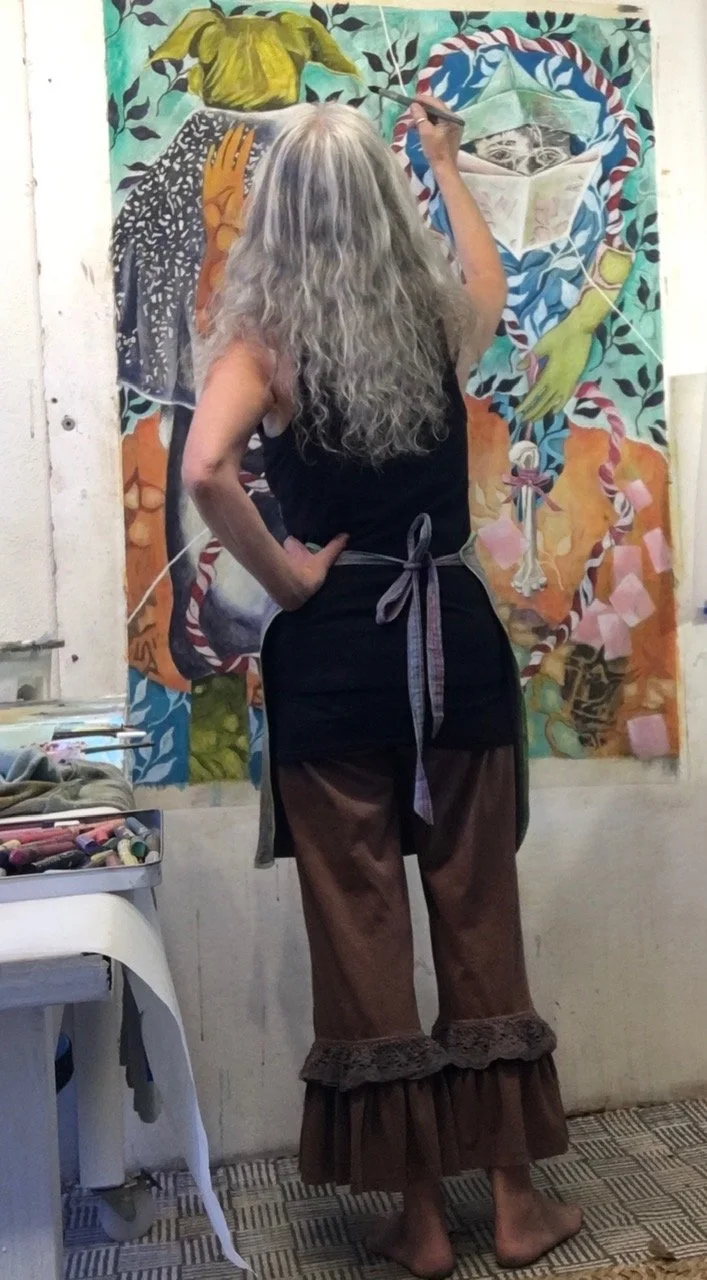
Beggar, 2024
An old friend with whom I have a lively penpal correspondence reminded me recently in an email to heed the second part of this title. Most likely I was whining in my last note to him about my latest rejection, even as much as I believe that doing the work is and should be my main preoccupation, and damn all of the outside voices. But as much as my introversion keeps me alone in the studio, there is a nagging need for some of those outside voices. What (or who?) defines success? And why do I feel mostly out of sync with the modern interpretation of that word? If being seen is a form of success, the internet has provided the stage. For those of us born pre-internet, this is sometimes a challenge.
Artists, a group of people who were often cloistered, locked away in creative chaos, have long joined the social media fray, some of us collapsing under the constant pressure to be “out there”. What can we do? The internet demands performance. Sometimes that performance is literal. I once saw an Instagram reel of an artist doing cartwheels in front of her painting. In today’s world of living out loud, artists are expected to shake off their introversion and perform for the world, not necessarily about deep ideas, but about themselves or their story on camera. It helps if the artist has a studio that is well photographed—large, with celestial light, or interesting in some industrial way. The kind of studio that probably 95% of working artists decidedly do not have. All of this performance creates a scenario where marginalized artists—however seriously working—feel like they have missed the boat. That boat being “success”.
Society and culture deem this word to be everyone’s endgame and the very reason you are alive. It is a word I have loathed since I was a teenager and in fact, still do because while success can and does mean many things, the most common definition of what it means to be successful is, money. There is a moral judgment that comes along with this striving as well. If you haven’t made a financial success of your art profession, it also means you must be at fault in some way. As a proper rebellious teenager of the counterculture, being on the fringes of the money-making machine is partly why I decided to become an artist. It felt like a higher, more pure calling, one that had nothing to do with commerce, because in those days, that idea actually felt true.
At this stage of my forty-five + years as as a working artist, I have thought back to pre-internet art school days and what I was told success might be. As an art student, I certainly don’t remember any discussions about the art market during seminars or critiques, although I did have a professor who once claimed that if you were selling a lot of work, it probably wasn’t very good. And another one who opined that it was easier to sell a mediocre painting than a truly good one. I take comfort in these declarations—however wobbly— when I view my own market (or lack thereof). From their academic bubble, my professors could view the market as evil—not to be considered if you were to be taken seriously as an artist. Even though I understood these remarks came from people who had the advantage of steady employment, they still influenced how I approached my own practice. The internet has seemingly changed all of that.
I am not trying to elevate the starving artist here. There is no nobility in starving, to be sure. Selling paintings is good and necessary. If only to keep making more of them. But what does it mean when visibility or heavy sales is automatically taken for artistic value? Is popularity the form of success artists desire? I struggle with this. People who shun popularity are often labelled elitist, too high-brow to wallow with the mundane or obvious. This has become the rally cry of new artists these days as in ban the gatekeepers! (but of course, even Instagram has its own gatekeeping). And yet, the gatekeepers still wield a good deal of power by way of access, visibility, and prestige, precisely because they are in a position to give it or take it away. The average person doesn’t know enough about art to make their own call, so if someone in a position of power says, “this is good,” there is a tendency to listen. Or at least consider. It would follow that artists at some point might enjoy the ear of that power. Artists are notoriously full of doubt, and sometimes, even a crumb of acceptance can bring us to face today, a painting that was going badly yesterday. Is that what is called success? On some level, to be sure. If an artist’s job is to communicate, then surely we want to be part of the conversation.
If your work is lucky to move into that kind of visibility however, the market is also waiting there, which of course is a very different animal. The catch-22 of getting the attention of a major gallery is that while they can position an artist to command increasingly higher prices for their work, usually artists must already demonstrate that demand before the gallery will consider them. (Galleries must pay their rent too). And once the artist’s importance is established, it seems the conversation about the work ceases and is replaced by a price tag as its main draw. It’s also not hard to see how artists —in the larger art world—can get swept up in this kind of heady notoriety.
The obscene auction prices in recent years have certainly accelerated this sales = artistic value = success ratio. Even Gerhard Richter in the 2018 documentary, The Price of Everything was appalled about one of his small paintings being sold for the cost of a house saying, “I like it (the painting), but it’s not a house.” A short excerpt clip ends with him saying “money is dirty”. When one of our most celebrated painters makes a statement like that, it feels significant. Does Richter’s age have something to do with this attitude? I think it does. And here, I must admit to being as “old-school” as Richter.
I always thought becoming an artist had to be earned. I expected to wait a lot of tables. It took me years before I could say “I am an artist,” with any solid conviction. These days, no one wants to wait that long. Some young artists are being put on the block while still in graduate school, even though it is often said, this early catapult is not necessarily good for the work in the long run. The internet is full of people who chuck their corporate job to become an artist because they deem that a more “fun” profession. Instagram has become one giant self-help book determined to tell you what you should be doing in order to live your best life, make your best art, be the most successful. Everything is “amazing!”, ideas rarely challenged or even asked about, and validation in the form of hearts and fire emojis seems to be sufficient. Rejection or criticism of even the most constructive kind has been given a bad wrap. Does rejection mean you are not successful? I have had a ton of it, and of course, it never feels good, but rejection can be a tool and a teacher. This, I learned in art school.
It has become very popular these days to denigrate art school or art education as not necessary for a life as an artist. While that may be true for some, I would like to give a shout out to my art education which I found absolutely necessary and invaluable (even though it sometimes made me cry). I understand that a lot of the current disdain comes from the price tag of such an education today. (full disclosure: I was lucky to pay nothing for graduate school, having been given grants, outside artist fellowships, and adjunct teaching to get me through, along with a 1989 price tag).
Art school demanded things of me. It demanded that I not only come up with solid ideas and know how to talk about them and write about them, but also to become self-critical and not fall in love with everything that I spewed onto paper or canvas. I had a drawing professor tell me that if I made 50 drawings, perhaps one of them might have some merit. success! Tough love, to be sure. But that toughness taught me to see better.
Getting an MFA was hard work and I truly believe helped me to cultivate discipline in my practice. I still believe in the value of that education today, even though I can’t “sell” the price any longer. I bristle when someone suggests to me that art school was somehow a less rigorous degree than say, biology. Nothing could be further from reality. The process of making art leaves you largely on your own to find your way. It is an exploration into a technical and introspective world, where process, art history, practice, craft, skill and ideas are all considered. In my experience, these things take years to develop. I am forever grateful for the required discourse and critique that helped me get there. With our social media mania, and rush to monetary success, I imagine the idea of working for years to develop your work before sending it out into the world now seems rather quaint to some young artists who have grown up with Instagram. I admit to feeling increasingly alone with these opinions, as artists who came up in my era begin to die off.
Social media has allowed artists to share their work with a vast audience by cutting out the middle gallery owners and also feel a certain kind of success by sharing it with others. This does have its place and I am grateful for it, even as I try to limit my use of it. But the Insta-world has created a new paradigm. Marketing and celebrity have become part of an artist’s bag of tricks, along with mega followers. Even major galleries and museums are parading their artists on Instagram reels “explaining” their work to the audience. This might sound like a good thing for art, but I am not sure.
Artists who feel more comfortable on camera or on an Instagram reel have a decided advantage today, but does it mean that their work is more worthy? I suppose that criteria will always be subjective. But we now live in an age of celebrity and the Warholian fifteen minutes has expanded into a lifestyle. One that is dangled on our screens everyday, asking us to take our measure. But that measure means nothing if you don’t find it first in the questions and the struggle that arise in the studio. And anyone who is serious about making art will tell you it’s a struggle. It should be. The struggle is what leads to the absolute thrill of getting something to click. That is the meaning of “doing the work” and where— when I take my own measure— I find success.